
We’ll also touch on how our doctors approach treatment planning. Dr. Gygle and Dr. Frick each bring a thoughtful and steady presence to our restorative care, which makes exploring your options feel easier from the start.
Fixed Crowns vs Fixed Bridges: What Makes Them Different?
Although fixed crowns and fixed bridges appear similar once in place, they serve different purposes and support oral health in distinct ways. A crown strengthens a single damaged tooth, while a bridge replaces one or more missing teeth by anchoring to nearby teeth. Most people only realize how differently these two solutions function once we walk them through each step in-person during a consultation.
Crowns protect teeth that can’t hold up on their own anymore. Bridges step in when a tooth is already gone. Once you know which problem you’re solving—weak tooth or missing tooth—the path forward starts to feel much more intuitive.
How a Fixed Crown Reinforces a Tooth
A fixed crown acts like a custom shield that covers the entire visible portion of the tooth. We use it when a tooth suffers from decay, fractures, or old fillings that no longer support biting pressure. We see patients who grind their teeth, crack a molar at lunch, or discover a cavity that grew faster than they expected. A crown restores strength in these situations, allowing the tooth to function normally again.
A well-designed crown blends smoothly with neighboring teeth. Once bonded in place, the tooth feels solid, secure, and ready for normal chewing. You also protect yourself from losing the tooth later, since the crown seals and reinforces what remains.
When a Fixed Bridge Makes the Most Sense
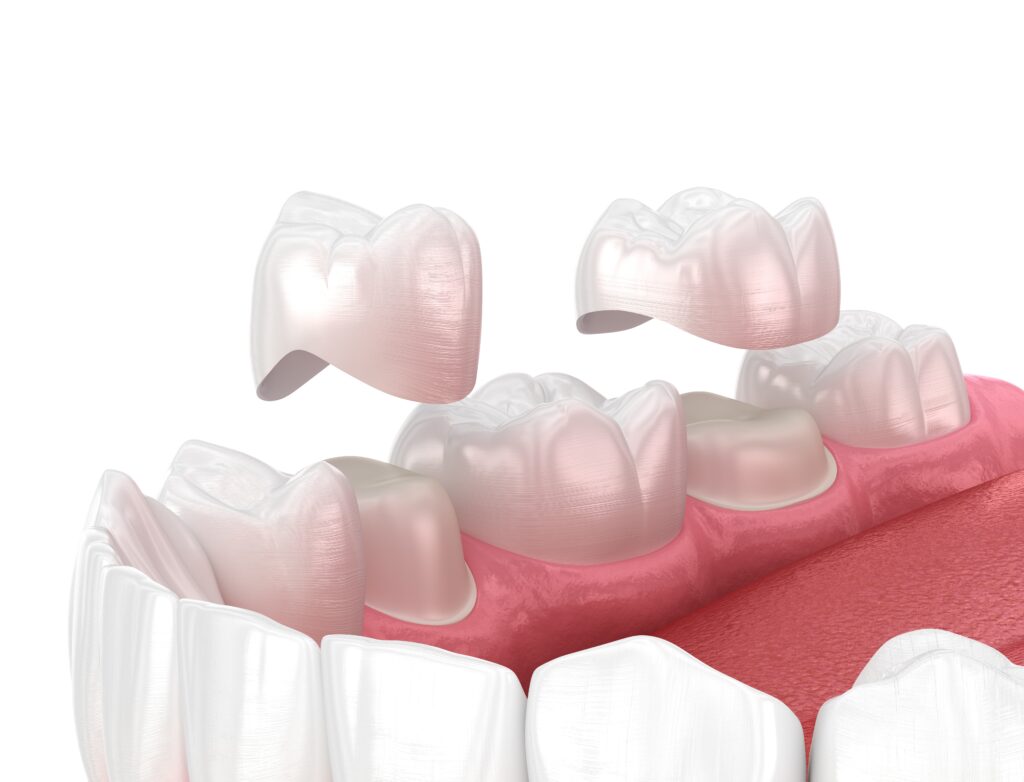
A fixed bridge replaces one or several missing teeth by connecting artificial teeth to natural teeth on each side of the gap. Those healthy teeth receive crowns, and the replacement tooth sits between them, forming a stable, durable row.
Patients who lose a tooth often feel surprised by how much that empty space affects their day-to-day life. Speech changes slightly. Chewing feels uneven. Food gets caught in places it shouldn’t. A bridge addresses these issues while preventing surrounding teeth from shifting, thereby protecting long-term alignment.
If you want a faster solution than implants and prefer something that doesn’t come in and out, a fixed bridge often becomes the right choice. It offers a reliable balance between simplicity and stability.
Deciding Which One Fits Your Needs
Even patients who come in “just wanting the best option” usually discover the best option depends on the story behind the tooth. A broken tooth that still has strong roots needs a crown. A tooth that already came out—or needs removal—requires a bridge if you want something fixed in place without surgery.
As we talk through these details, patients often appreciate a clear breakdown of how the two treatments compare in real-life scenarios. Here’s how we usually explain it during an appointment:
- You keep the original tooth? A crown restores it.
- Is the tooth gone? A bridge fills the space.
- Do you need the simplest structural reinforcement? Crown.
Once we settle on the direction, everything else becomes much more straightforward.
Cosmetic Advantages in Millcreek
People in Millcreek often tell us they want restorations that feel “normal.” They want to smile at a neighbor, laugh with a friend, or take a family photo without a second thought about their teeth. Both crowns and bridges provide natural-looking results that blend seamlessly with your facial features and match your shade precisely.
Crowns give each tooth an individual makeover. Bridges recreate an entire section of your smile. Either way, you get a smooth, confident look without drawing attention to the work you’ve had done. That balance—restoration without spotlighting—is something our patients appreciate.
Structural and Functional Benefits
The real value of both crowns and bridges becomes obvious when you feel the difference during everyday activities. You can eat normally, speak clearly, and maintain better hygiene overall. Some patients even realize how much they had been avoiding certain foods or chewing patterns until they finally feel the stability of their restoration.
Here’s how each solution supports the function:
- Crowns: Reinforce remaining tooth structure and stop cracks from spreading.
- Bridges: Distribute bite pressure evenly by filling the gap left by a missing tooth.
- Both: Restore symmetry, align the bite, and reduce strain on surrounding teeth.
Once restored, patients often feel like their smile “turned the corner.”
Longevity and Care
A major concern patients bring up revolves around durability. People want to know how long their investment will last and what day-to-day care entails. Fortunately, crowns and bridges hold up well when you maintain solid oral hygiene habits.
Crowns typically last many years because they protect the tooth from pressure, temperature changes, and further decay. Bridges also last a long time, but they require regular attention to the gums and teeth that support the structure. Small adjustments—such as learning to thread floss under the bridge—make routine care easier.
When patients follow our care instructions and keep routine dental visits, both options provide predictable performance. Long-term comfort becomes entirely realistic.
What an Appointment Usually Looks Like
Because patients like to know what to expect, here’s how a typical visit unfolds:
1. Evaluation and Planning
We examine your teeth, take digital scans, and discuss openly what you feel, what you want, and what makes the most sense.
2. Preparing the Tooth or Space
A tooth getting a crown receives shaping and smoothing so the crown fits well. A bridge requires shaping the anchor teeth to support their crowns.
3. Designing the Restoration
We create a custom match for your tooth shade, contour, and bite. At this point, we ensure the final result blends with your natural smile.
4. Final Placement
Once the restoration fits perfectly, we cement it in place. You leave the office with renewed function and stability.
If you need directions to our Millcreek practice, the location link here helps.
The Role of Technology in Precision
Modern dentistry gives us tools that create incredibly accurate restorations. Digital imaging allows precise measurements and a more natural fit. This matters because both crowns and bridges rely on exact contours to feel comfortable. When everything lines up perfectly, chewing becomes smoother, and the restoration stays firmly in place.
Patients appreciate this accuracy because it leads to better comfort from day one. There’s something reassuring about a process that feels simple and predictable.
Cost, Membership Plans, and Practical Considerations
Many patients ask about affordability during their first visit. While each case differs, both crowns and bridges offer long-lasting value. They also help prevent future expenses by reducing wear, preserving alignment, and improving oral stability.
Patients who want consistent costs often explore our in-house membership plan. It adds convenience to routine care and keeps dental maintenance predictable.
You can also contact our team directly through our site if you prefer speaking with someone right away:
Ready to Explore Your Best Option?
If you’re thinking about Fixed Crowns vs fixed Bridges and want guidance that feels personal, supportive, and down-to-earth, we’re here to help. Our team at Mark’s Dentures Lab works closely with every patient to create a plan that fits their needs, lifestyle, and vision for their smile.
Schedule your appointment today and take the first step toward a strong, confident, long-lasting restoration. We provide restorative dentistry, preventative dentistry, implant-supported dentures, and much more!